The Key to Connection: Honesty
Meet the Rutgers STEM Mentor, Dr. Gene Hall!
What does it mean to pay it forward?
“I even had one student ask me how much money I made. It’s a valid question!” Professor Gene Hall fondly recalled his participation in the 4-H Youth STEM Ambassadors Kickoff last July.
A professor of Analytical Chemistry at Rutgers University’s Department of Chemistry and Chemical Biology, Dr. Hall saw an opportunity to engage with a new audience and encourage new interests in STEM. The program is focused on high school students, from across New Jersey, who are just starting to figure out what paths they want to try after high school.
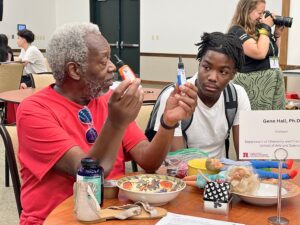
At the program’s Rutgers Researcher Roundtable, Dr. Hall fielded some standard questions any curious young student might wonder, including ‘why did you do this?’ ‘And who was your mentor?’
He also fielded more specific questions, like ‘If I take this route as a forensic chemist,how long do I have to go to school?’.
That last question had to do with what Dr. Hall brought with him to the roundtable: a counterfeit $100 bill. Dr. Hall’s lab identifies knock-off consumer products, like dietary supplements and beauty products. As such, he wanted to center analytical chemistry in his roundtable discussions, shifting the students’ perceptions from the stereotype of a scientist in a white coat in a sterile lab to the reality of his lab. He took them step-by-step on how they could use the same analytical skills one would use in a lab right then and there (with the help of a really good phone camera).
Interacting with young students who are weighing their own post-school options meant utilizing a different set of communication skills than the skills he uses in his academic field or collaborating with government and industry. He consciously fashioned the conversation to dismantle any subconscious feelings of intimidation that the students might have felt.
“I made sure I broke the ice because I wanted to make them feel at ease. I said, ‘call me Gene.” He also found that some of the questions the STEM Ambassadors had were similar to questions his undergraduate students had.
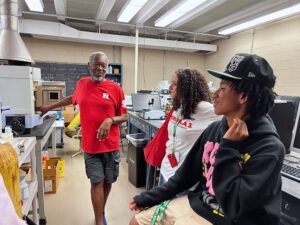
Paying It Forward
When Dr. Hall was five years old, he knew he wanted to be a chemistry professor after his parents gifted him a chemistry set. However, when he was in high school, his guidance counselor pushed him towards trade school. However, in his senior year, he had a new guidance counselor–one who took one look at his grades and told him to go to college. It was this interaction that shifted his journey from a very happy auto mechanic to a very happy analytical chemistry professor. He learned that he couldn’t let other people define him and his path. There were so many paths out there and he had many options.
This is a lesson he hoped his STEM Ambassadors took from the roundtable, as well. “It felt great because, as a role model, it’s really nice to show them ‘Hey, if I can do it, you can do it,’” he reflected. “If I can help one student then that student maybe can help another student. And then you have a multiplication effect.”
He also left the students with an avenue of contacting him for further questions and suggestions on chemistry summer camps for them, including Project Seed from the American Chemical Society. He knows that it’s community and positive mentorship that keeps a student going. Throughout his own academic journey, it was his own faculty mentors and home community that encouraged him and his work on the day-to-day. Now, he’s doing the same.